
Choosing the right label format is an important part of product identification, packaging and printing operations. Businesses that use self-adhesive labels often need to decide between roll labels and sheet labels based on their printing equipment, application requirements, order quantity and handling preferences.
Although both formats serve similar labeling purposes, they differ in how labels are arranged, dispensed, printed and applied. Understanding these differences can help businesses select a suitable label format for their day-to-day operations.
In this guide, we explain the differences between roll labels and sheet labels, their applications, advantages and the factors to consider when selecting a format for your business.
What Are Roll Labels?
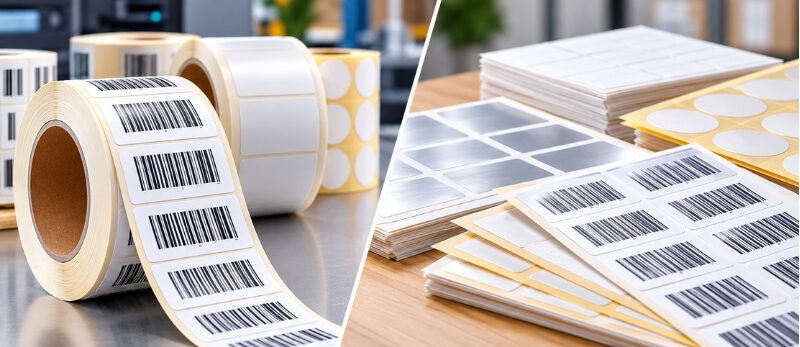
Roll labels are self-adhesive labels supplied on a continuous backing wound around a core. Individual labels are arranged in a sequence and dispensed as the roll moves through a compatible printer or label applicator.
This format is commonly used in businesses that require repeated labeling, organized production workflows or compatibility with automated dispensing equipment.
Common Applications of Roll Labels
Roll labels are suitable for a wide range of commercial and industrial applications, including:
- Product packaging: Labels for bottles, jars, containers and packaged goods.
- Barcode identification: Labels used for product coding, inventory management and stock tracking.
- Warehouse operations: Identification labels for cartons, bins and stored products.
- Retail products: Price, product information and identification labels.
- Batch identification: Labels carrying batch numbers, production details and other variable information when supported by the printing process.
Advantages of Roll Labels
Suitable for repeated labeling: The continuous roll format supports applications that require labels to be dispensed one after another.
Compatible with suitable label printers: Many thermal and thermal-transfer printers use roll media, subject to printer specifications and label dimensions.
Useful for automated application: Rolls can be used with compatible automatic or semi-automatic label applicators.
Flexible label quantities: Roll formats can be specified for different production volumes, depending on the supplier’s capabilities and minimum order requirements.
What Are Sheet Labels?
Sheet labels are individual self-adhesive labels arranged on flat sheets, with each label separated by die-cut lines or another suitable cutting arrangement. Depending on the product, sheets may contain multiple labels of the same size or different label designs.
Sheet labels are commonly used for office printing, small production runs, product identification and applications where labels are handled or applied individually.
Common Applications of Sheet Labels
Sheet labels can be useful for:
- Office and document labeling: File labels, address labels and identification stickers.
- Product identification: Labels for products that require individually handled stickers.
- Small-batch packaging: Labels for limited production runs, samples or product variations.
- Promotional stickers: Printed labels for marketing materials and promotional packaging.
- Inkjet and laser printing: Compatible sheet labels for printing designs, text or other information using supported office printers.
Printer compatibility depends on the label material, adhesive, sheet construction and the equipment manufacturer’s specifications.
Advantages of Sheet Labels
Convenient for smaller jobs: Sheet formats can suit businesses that need limited quantities or several label designs in one print run.
Easy to handle individually: Flat sheets can be stored, transported and distributed without dedicated roll-dispensing equipment.
Suitable for compatible office printers: Certain sheet labels can be printed using supported inkjet or laser printers.
Useful for multiple designs: Different label layouts can be arranged on sheets where the product specifications allow it.
Roll Labels vs. Sheet Labels: Key Differences
The main difference between roll labels and sheet labels is how the labels are supplied and handled. The right option depends on the intended application, printing equipment and workflow.
| Comparison Factor | Roll Labels | Sheet Labels |
|---|---|---|
| Format | Labels wound around a core | Labels arranged on flat sheets |
| Printing Equipment | Compatible roll label printers | Compatible sheet-fed printers |
| Application | Manual, semi-automatic or automatic dispensing | Usually handled and applied individually |
| Production Workflow | Often suited to repeated labeling operations | Often suited to smaller or varied print jobs |
| Storage | Requires space for rolls and suitable handling | Can be stored flat in suitable packaging |
| Design Variations | Multiple designs may be produced in separate rolls or specified configurations | Multiple designs may be arranged on one sheet, depending on the layout |
| Common Applications | Product packaging, barcodes and inventory labels | Office labels, promotional stickers and small-batch applications |
Neither format is universally better. A business should select the format that best matches its printing process and labeling requirements.
Which Label Format Is Better for Your Business?
Selecting between roll labels and sheet labels involves more than comparing the physical format. Consider the following factors before placing an order.
1. Printing Equipment
Start by identifying the printer you plan to use. Roll label printers and sheet-fed office printers generally require different media formats. Confirm the supported label dimensions, material, thickness and feed specifications before selecting a product.
2. Label Application Method
Consider how the labels will be applied. If labels need to be dispensed continuously or applied using an automated system, a compatible roll format may be more suitable. For manual labeling or individual sticker distribution, sheet labels may be a practical option.
3. Order Quantity and Frequency
Businesses that label products regularly may benefit from a roll-based workflow. Sheet labels may be appropriate for smaller jobs, samples or occasional printing. However, actual cost and production efficiency depend on order volume, setup requirements and the supplier’s pricing.
4. Label Material and Adhesive
Choose the material according to the product surface and operating conditions. Paper and filmic materials offer different characteristics, while adhesive selection affects how the label bonds to the intended surface.
For products exposed to moisture, heat, friction or outdoor conditions, confirm that the complete label construction is suitable for the environment.
5. Label Size and Design
The dimensions, shape, artwork and spacing of labels can influence the appropriate format. Confirm the required label size, gap, core diameter where applicable, sheet layout and printing specifications before production.
Can the Same Label Design Be Produced in Rolls and Sheets?
In many cases, a similar label design can be produced in either roll or sheet format. However, the material, adhesive, cutting layout and production method may need to be adjusted to suit the selected format.
For example, a product identification label may be required in rolls for repeated application on a packaging line, while a smaller quantity of the same design may be needed in sheets for manual use.
The final format should be confirmed against the printing equipment, label dimensions and intended application.
Common Industries That Use Roll and Sheet Labels
Both formats serve different requirements across commercial and industrial sectors.
FMCG and Product Packaging
Roll labels are frequently used for product packaging where labels need to be dispensed repeatedly. Sheet labels may be suitable for samples, small-batch products or limited packaging runs.
Warehousing and Logistics
Barcode and identification labels help businesses organize stock, identify storage locations and support inventory workflows. Roll formats may suit repeated printing, while sheet formats can be useful for individually handled labels.
Retail and Distribution
Product identification, pricing and promotional labels may be required in either format, depending on the retailer’s equipment and application process.
Manufacturing and Industrial Operations
Industrial businesses may use labels to identify equipment, components, containers and products. The choice of format depends on the label material, operating environment and method of application.
How to Choose the Right Self-Adhesive Label Format
Before requesting a quotation, prepare the following information:
- Required label dimensions and shape.
- Roll or sheet format preference.
- Label material and adhesive requirements.
- Printing method and artwork.
- Quantity required and expected order frequency.
- Application surface and environmental conditions.
- Any barcode, variable-data or finishing requirements.
Providing these details helps a label supplier evaluate the appropriate product construction and production format.
Roll and Sheet Label Solutions from Diamond Stickers
Diamond Stickers, operated by Dinsons Self Sticks Pvt. Ltd., provides self-adhesive label solutions in roll and sheet formats for product identification, barcode printing, packaging and specialized applications.
With in-house printing and converting capabilities, the company supports businesses and distributors seeking label formats suited to their operational requirements.
Whether you are evaluating roll labels for repeated application or sheet labels for individually handled stickers, identifying your printing method, label specifications and intended use is the first step toward selecting the right format.
Contact Diamond Stickers to discuss your self-adhesive label requirements and available roll and sheet options.
Frequently Asked Questions
Roll labels are wound around a core for dispensing from a roll, while sheet labels are arranged on flat sheets. Their suitability depends on the printer, application method and production workflow.